Ephesus Aphrodisias and Pamukkale Tours
3 Days Ephesus Aphrodisias and Pamukkale Tours

A marvellous 3-day journey! Discover fascinating ancient ruins in Ephesus, observe a place full of art and history in Aphrodisias, relax in the white travertines of Pamukkale. This tour offers an adventure full of history and the beauties of nature.


PS: Please bring your bathing suits and towels.
16:00 End of the Pergamon Day Trip- Depart from Pergamon to Izmir Airport.
19:30 Flight from Izmir to Istanbul.
20:30 Arrive in Istanbul. Transfer back to your hotel in Istanbul.
05:00 Early morning transfer to Istanbul Airport.
07:00 Direct Flight from Istanbul to Izmir.
08:10 Arrive at Izmir, meet your Ephesus guide, and drive to Selcuk (Ephesus).
09:15 Arrive in Selcuk or Ephesus.
09:20 Full-Day Ephesus Tour. Overnight in Kusadasi.
After meeting your Ephesus guide in Ephesus, your local tour guide will hand you; Ephesus Map and a Turkey Map.
We will pass through the verdant and picturesque countryside; our first stop will be The House of the Virgin Mary. By the Predominant Christian tradition, Mary was brought to Ephesus by the Apostle John after the resurrection of Christ and lived out her final resting years here. This is based mainly on the traditional belief that John came to Ephesus and the biblical statement that Jesus consigned her to John's care (John 19:26-27).
After The House of the Virgin Mary, we will head on to the next destination, the Ancient City of Ephesus; the tour here shall be a walking tour and will take you through one of the most magnificent archaeological sites in the world.
You will see the Odeon, The Fountain of Trajan, the steam baths of Scholastic, the Temple of Hadrian, and course, let’s not forget the awe-inspiring library of Ephesus. The library is adorned with columns and statues. The Grand Theatre, where Saint Paul preached, is the largest in antiquity, with a capacity of 24.000 seats.
You will then return to the bus through the Arcadian Way, where Mark Anthony and Cleopatra once rode in procession. After your 2-hour exploration around Ephesus, we will head for a lunch break for about 1 hour is Lunch Break.
Our next stop is the Temple of Artemis (Diana). This outstanding temple was built in honor of the Greek Goddess of hunting, wild nature, and fertility, deemed one of the Seven wonders of the ancient world. The temple of Artemis used to be the largest marble temple in the ancient Greek world since it was four times as big as the Parthenon in Athens, Greece.
The temple served as both a marketplace and a religious institution. Offerings by thousands of pilgrims each year enabled the temple to grow so wealthy that it became the world`s first bank. Today, little remains of the magnificent structure.
Your guide will describe its importance, wealth, and the tension between the Romans and Christians that settled in the area over the centuries. After the Ephesus tour, drive back to Kusadasi overnight.
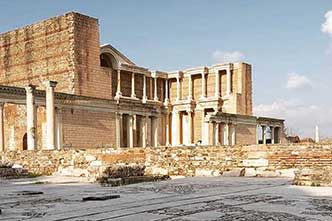
The Museum of Aphrodisias is one of the most outstanding museums in western Anatolia. The monuments of unsurpassed value, which have been found at the excavations, are displayed here. Once the tour ends, it will be time to return to the bus and be driven back to your allocated drop-off points; we trust your tour with us today has been excellent.
What other artifacts are displayed at the Museum of Aphrodisias? - Statue of Aphrodite of Aphrodisias, The shield portraits(Pythagoras, Socrates, Pindar), The statue group represents Achilles supporting the dying Amazon queen Penthesileia, The Centaurs at Banquet, Selene (Goodes of the moon) is in a chariot, night fights giants, and From Sebastion and The Statue of Aineias flight from Troy.
After the Aphrodisias, we will have a local lunch. Then we will drive to Pamukkale.
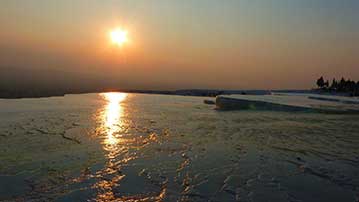
"Pamukkale translates to 'Cotton Castle'... Once you get here, it's easy to see why. This natural phenomenon; designated a UNESCO Heritage site in 1988, with spectacular white calcium cliffs and beautiful turquoise blue pools, is truly a sight to behold. Pamukkale is like an alien landscape;
Pamukkale, or ‘Cotton Castle’ when translated, has been drawing tourists worldwide to its thermal springs for more than 23 centuries. Pamukkale and Pamukkale Tours is one of the top Famous Turkey Trips. The Turkish name refers to the extraordinary surface of the snow-white cliffs, shaped over millennia by the accumulation of calcium deposited by mineral springs.
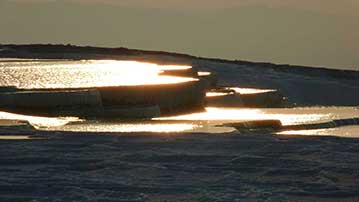
Legend has it that the Cotton Castle formations are solidified cotton (the area’s principal crop) that giants left out to dry. Dripping slowly down a vast mountainside, mineral-rich water foams and collects in bowls that terrace the decline down the mountainside spilling over petrified cascades of stalactites into milky pools below. These saucer-shaped travertines (or terraces, as they’re also called) wind sideways down the powder-white mountain, providing a stunning contrast to the clear blue sky and green plain below.
To protect the unique calcite surface, you are obliged to traverse the area barefoot. Although the terrace pools aren't bottomless, you can get fully submerged if you want, don’t forget your towel! Don’t worry, if you don't have a bathing suit or towel, you can buy a Turkish Towel, Do not Forget is Cotton’s principal crop. As a nice suvinour, you can take away to your home. You shouldn’t leave Pamukkale Tour without having a healing dip in the sacred fountain of Cleopatra’s pool.
A swim in the effervescent waters of Cleopatra’s Pool should be at the top of any Turkey Travel Itinerary. Strewn about the bottom of the crystal-clear pool is an amazing collection of striated columns and capitals, a striking reminder of the pool's pedigree.
Cleopatra's Pool has warm clear fizzy water that bubbles from the source of the spring, but these days has now been blocked off to prevent divers from disappearing into its hidden depths. With temperatures of 35C, you can bathe in the natural thermal mud and waters and enjoy the water's curative effects (both medicinal and beauty), which had previously benefited the ancient Greek and Roman peoples for centuries. With its Thermo mineral and magnesium, calcium, carbon dioxide, sulfide, and bicarbonate, this curative water suits many areas as a curative treatment.
The nearby ancient Hierapolis and its accompanying museums may be overshadowed by the springs, but they are also fascinating and well worth the visit. After walking along the terraces, we will take a short walk to Hierapolis City, also known as ‘Holy City.’ Just outside the main entrance is the Necropolis (Graveyard), containing more than 1200 tombs and sarcophagi of people who wished to have been buried here.
The proximity of the hot springs and vapor-emitting cracks was believed to ease their journey into the Underworld. Among the tombs lies the Martyrium, an octagonal 5th-century edifice believed to have been erected upon the site where St. Philip was martyred in 80 CE. The Hierapolis City Bath, the springs of Hierapolis, were particularly popular among vacationing Romans.
You will notice that carved into the side of the mountain is the monstrous Grand Theater that dominates the vista of Hierapolis At its height, the Grand Theatre could host 25.000 boisterous fans and is still largely intact until this day. It features a vast network of decorative elements from the 3rd century CE, including ornately sculptured statues, columns, and arches, amongst other decretive elements.
17:00 End of the Pamukkale Day Tour
17:00 Depart from Pamukkale to Kusadasi.
20:00 Arrive in Kusadasi. Overnight in Kusadasi
What’s Included?
What’s Excluded?


This is a sample text. You can click on it to edit it inline or open the element options to access additional options for this element.
Suleyman Demirel Blv. Sengel Melis Apt.
B Blk K 4 D 15 09400 Kusadasi Turkey


American Society of Travel Agents